


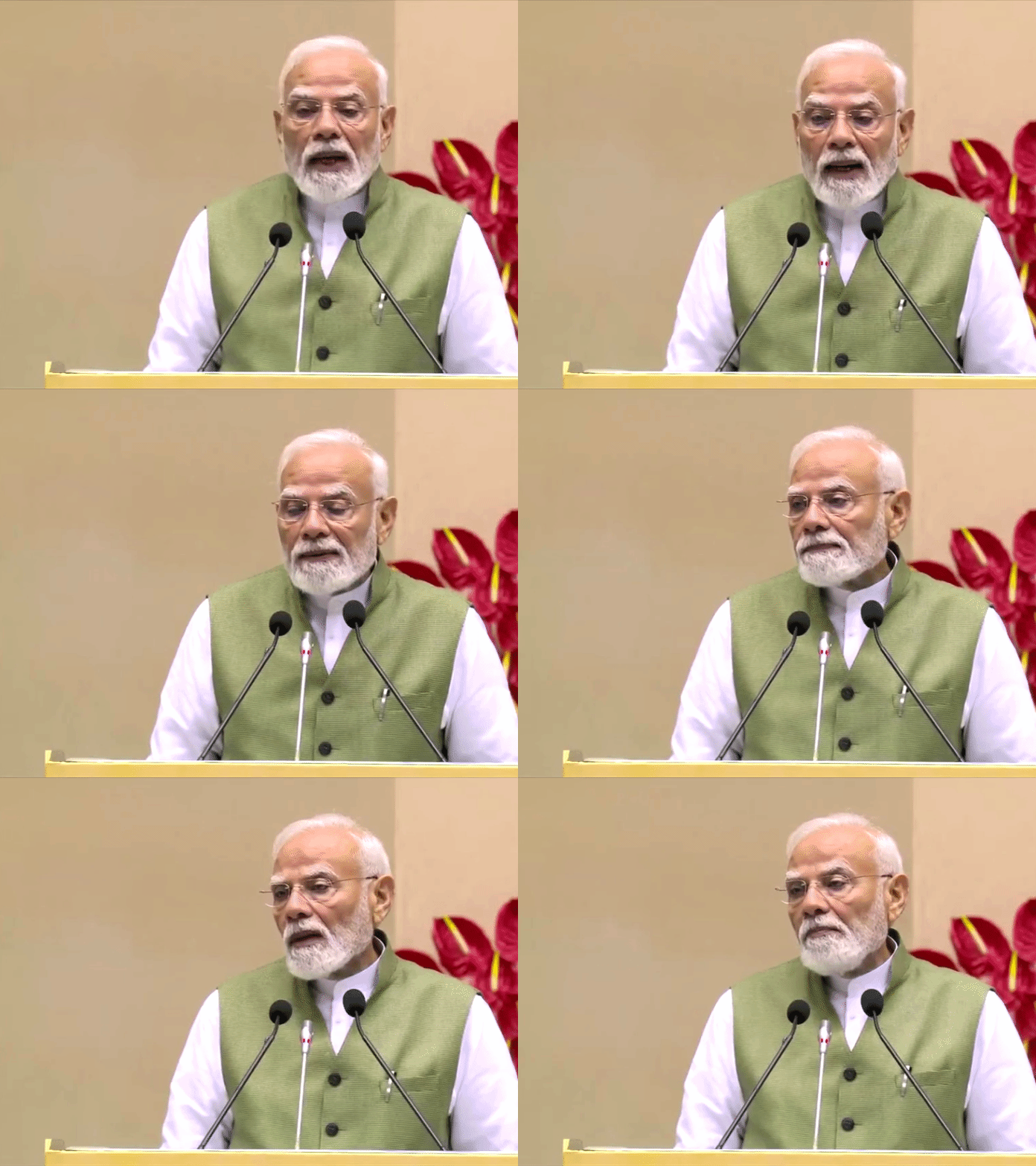
Prime Minister Narendra Modi delivered a detailed address on Saturday at the inaugural session of the international conference titled “The Future of Environment and Climate Dynamics” in New Delhi. In his speech, Modi emphasized that developed nations emit roughly six times more carbon per person than India, yet the discourse on climate change often places the burden of responsibility on developing countries. He underscored that India’s per‑capita carbon emissions are less than half of the global average, a fact that, according to him, is frequently overlooked in international climate negotiations.
The concept of per‑capita emissions is central to understanding a nation’s climate impact. It is calculated by dividing a country’s total carbon output by its population, providing a clearer picture of individual contribution rather than aggregate totals. By highlighting this metric, Modi sought to illustrate that while India’s overall emissions may be significant due to its large population, the average Indian’s carbon footprint remains comparatively modest.
Modi’s remarks were placed within the broader context of global climate responsibility. He argued that attributing climate change liabilities primarily to developing economies is inequitable, especially when the data shows a stark disparity between the emissions levels of advanced economies and those of nations like India. The prime minister’s statement was part of a larger conversation that has been ongoing since the landmark Paris Agreement, where countries pledged to curb greenhouse‑gas emissions and adapt to the impacts of a warming planet.
The speech also touched upon India’s energy strategy. Modi announced that the government is actively working to accelerate nuclear energy production as a component of a cleaner energy mix. He framed this initiative as essential for meeting growing energy demand while keeping carbon emissions in check. “We are committed to expanding nuclear power to ensure energy security and environmental sustainability,” he said, linking the expansion directly to the nation’s climate goals.
In a pointed observation, Modi noted a perceived contradiction among some environmental advocates. “Those who deliver grand speeches about protecting the environment often oppose our nuclear projects and resort to legal challenges to halt them,” he commented. This remark highlighted a tension between rhetorical support for climate action and practical opposition to specific low‑carbon technologies. The provided speech summary did not name any particular court cases or parties involved in such legal actions, leaving the specific instances unspecified.
The conference, “The Future of Environment and Climate Dynamics,” serves as a platform for experts, policymakers, and scientists to discuss emerging trends in environmental science and climate policy. Its timing aligns with renewed global focus on meeting the commitments made under the Paris Agreement, which was adopted at the 21st Conference of the Parties (COP‑21) held from 30 November to 12 December 2015 in Paris, France. Approximately 195 countries participated in that summit, resulting in the Paris Agreement—a universal accord aimed at keeping the rise in global average temperature “well below 2 °C” and pursuing efforts to limit it to 1.5 °C above pre‑industrial levels.
Under the agreement, each signatory nation is required to formulate and implement nationally determined contributions (NDCs) that outline concrete steps to reduce carbon emissions and enhance resilience to climate impacts. India, as a party to the accord, has articulated its own targets, which are consistent with the broader objective of limiting warming while pursuing sustainable development. The prime minister’s emphasis on per‑capita emissions and the need for a balanced approach to climate responsibility reflects India’s stance in these global negotiations.
In addition to the climate discourse, the article mentions another development concerning India’s economic and technological ambitions. The government is preparing to transform the country into a semiconductor hub, aiming to boost domestic chip production and reduce reliance on imports. Prime Minister Modi inaugurated the fifth edition of Semicon India 2026 at Delhi’s Yashobhoomi, signaling the administration’s commitment to fostering a robust semiconductor ecosystem that could support everything from consumer electronics to automotive applications.
Overall, Modi’s address combined statistical advocacy—highlighting India’s relatively low per‑capita emissions and the disproportionate output of developed nations—with a forward‑looking energy policy that prioritizes nuclear expansion. By juxtaposing these themes, he reinforced India’s position that climate responsibility must be calibrated to historical emissions, economic capacity, and developmental needs. The speech also underscored the ongoing debate over how best to achieve environmental goals, noting that even well‑intentioned opposition can sometimes impede progress on critical low‑carbon infrastructure.
The conference continues over several days, offering sessions that delve deeper into climate modeling, renewable energy innovations, and policy frameworks. As nations gather to review their NDCs and discuss enhanced ambitions, Modi’s remarks serve as a reminder that equitable climate action requires recognizing the diverse circumstances and contributions of each country, particularly when it comes to per‑capita emissions and the pathways chosen for a sustainable energy future.